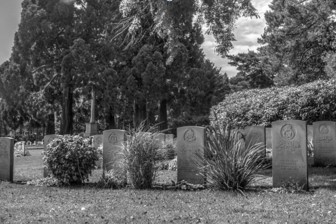
Brookwood Cemetery is a Grade I listed Historic Park & Garden. It was also known as the London Necropolis or...
Brookwood Cemetery is a Grade I listed Historic Park & Garden. It was also known as the London Necropolis or...
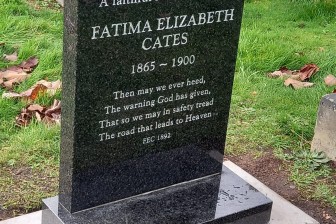
Fatima Elizabeth Cates (5 January 1865-29 October 1900) was probably the first woman to convert to Islam in Merseyside, who...
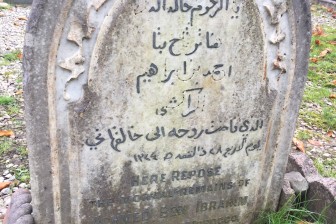
The discovery of the grave in Preston dating from 1906 baffled the Muslims community in Preston — how did a...
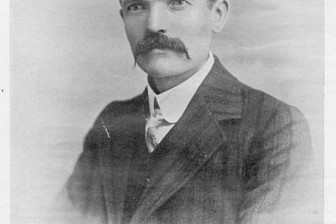
Yahya Parkinson (1874-1918), Scottish Muslim poet, essayist, and critic, was born in Kilwinning, Ayrshire, Scotland, of Irish descent. Born John...
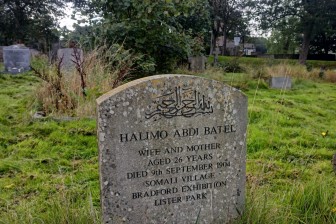
Halimo Abdi Betal (1878-1904) is probably the first Muslim to have been buried in Bradford; she died at the young...

Eternal Gardens was launched in 2013 to provide a dedicated Muslim Cemetery for the South East community. Their mission is...
9 September 1904
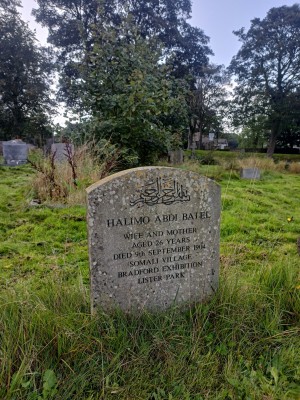
Halimo Abdi Betal (1878-1904) is probably the first Muslim to have been buried in Bradford; she died at the young age of 26 from tuberculosis, leaving behind a husband and a child. She came from Somaliland as part of a troupe of a hundred people who stayed in what was presented as a Somali Village (see the dedicated entry on this as part of the "Human Zoo" collection) at the Bradford Exhibition of 1904. Sixty were men, twenty were children and twenty were women. They were the most popular part of the Exhibition and 348,550 people paid to visit them within their compound over a six-month period. Overall, 2.4 million people visited the Exhibition as a whole.
Her death at the camp caused discomfort in the local press. It was reported that she had contracted tuberculosis on a previous visit to England in the 1890s, as part of Carl Hagenbeck's African Exhibition of 1895 at the Crystal Palace in Sydenham, London, where a troupe of 66 Somalis performed as riders of camels and horses. She would have been only 17 at that time. The press claimed that Halimo had never fully recovered from tuberculosis after returning home to Somaliland, and that it had only resurfaced by her returning to tour in Europe, first in Nice, France, and then in Bradford between May and September of 1904. The weather was particularly cold in May and June, and Halimo's health deteriorated. On 17 May, a local doctor was called in to attend to her, but she remained sufficiently unwell to remain confined indoors until her demise.
Halimo expired in the early hours of 9 September and she was buried with full Islamic rites that same evening, after sunset, at the Scholemoor Cemetery in Bradford. A cortege left Lister Park after 6pm carrying Halimo's body wrapped in cloth on a hearse provided by the local police. The funeral service was described as "sad and imposing" by the Bradford Daily Telegraph, and both the procession and the service attracted considerable crowds. Two days before they left Bradford for good, the men of the community went to pay their last respects at Halimo's graveside.
Halimo's grave remained unmarked for a century, until historians Christine Hopper and Farena Bashir at the Cartwright Hall relocated it. A headstone (pictured) was installed at the centenary of her death. The Telegraph & Argus reported that "Scholemoor Cemetery's Muslim registrar Abdul Haq Pandoor and his deputy Muhammid Riaz, said a prayer over the headstone inscribed with a verse from the Koran."
The plot number is Sec.J, No.682, Unconsecrated, and it lies about 100 metres south-west of the Crematorium (see the pin on the location above). The cemetery is open at all times to pedestrians but vehicle access is restricted to 9.30am to 8.30pm from April to September, and 9.30am to 4.30pm from October to March.

Britishnewspaperarchive.co.uk
“Centenary Stone for Halimo’s Grave.” Bradford Telegraph and Argus. 25 June 2004. https://www.thetelegraphandargus.co.uk/news/8001282.centenary-stone-for-halimos-grave/.
West Yorkshire Archive Service, Bradford, BBD1/1/48/46 - Cartwright Memorial Hall Exhibition [1904], Record of Admissions and Receipts, Somali Village, etc., p.18.
Spotted an issue Report this record
Loading please wait