
Title: My Son the Fanatic (1997)Director: Udayan PrasadWriter: Hanif KureishiProducer: Chris Curling, Jonathan Cavendish, and Nicolas KentStarring: Om Puri, Akbar...
Title: My Son the Fanatic (1997)Director: Udayan PrasadWriter: Hanif KureishiProducer: Chris Curling, Jonathan Cavendish, and Nicolas KentStarring: Om Puri, Akbar...

Title: My Beautiful Laundrette (1985)Director: Stephen FrearsWriter: Hanif KureishiProducers: Tim Bevan and Sarah RadclyffeStarring: Gordon Warnecke, Daniel Day-Lewis, Saeed Jaffrey,...

Title: The Message (1976)Director: Moustapha AkkadWriter: H.A.L. Craig (screenplay), Moustapha AkkadProducers: Moustapha AkkadStarring: Anthony Quinn, Irene Papas, Michael AnsaraSummary and...

Title: Children of Heaven (1997)Director: Majid MajidiWriter: Majid MajidiProducers: Mohammad EsfandiariStarring: Amir Farrokh Hashemian, Bahare Seddiqi, Mohammad Amir NajiSummary:“Children of...

Birmingham Central Mosque, located in Highgate, is one of the UK’s most prominent Islamic institutions and a key hub for...
16 November 1985
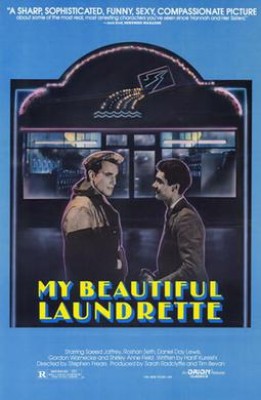
Title: My Beautiful Laundrette (1985)
Director: Stephen Frears
Writer: Hanif Kureishi
Producers: Tim Bevan and Sarah Radclyffe
Starring: Gordon Warnecke, Daniel Day-Lewis, Saeed Jaffrey, Roshan Seth, Shirley Anne Field
Summary:
Released in 1985, “My Beautiful Laundrette” is a seminal British film that deftly navigates themes of race, class, sexuality, and identity within Thatcher-era Britain. Written by Hanif Kureishi, the film tells the story of a young British Pakistani man, Omar (Gordon Warnecke), who partners with his childhood friend and lover Johnny (Daniel Day-Lewis) to transform a decrepit laundrette into a thriving business. The film explores the intersections of immigrant aspirations, family expectations, and personal identity, presenting a groundbreaking depiction of the British Muslim experience in a multicultural but divided society.
Plot Overview:
Omar is a British Pakistani teenager living in London with his alcoholic father (Roshan Seth), a disillusioned former journalist who has grown critical of British society. Seeing little hope for Omar’s future, his father arranges for him to work for his entrepreneurial uncle, Nasser (Saeed Jaffrey), a wealthy and influential figure within the British Pakistani community. Nasser owns several businesses and lives a life of relative luxury, embracing capitalist ideals as a means to climb the social ladder.
Through Nasser’s mentorship, Omar is given control of a failing laundrette. Determined to succeed, Omar recruits Johnny, a white British working-class man with whom he shares a complicated romantic history. Together, they renovate the laundrette into a vibrant and stylish establishment. However, their partnership faces numerous challenges, including tension within Omar’s family, Johnny’s ties to a racist gang, and the pressures of living in a society fraught with racial and economic inequalities.
Ambition and Identity:
The film captures the aspirations of British South Asians, particularly Muslims, who navigate the dual pressures of preserving their cultural heritage while striving for economic success in Britain. Nasser epitomises the immigrant entrepreneur, using capitalism to assert his place in British society. However, his unapologetic embrace of materialism and occasional moral compromises reflect the challenges immigrants face in balancing ambition with cultural and personal integrity.
Omar, on the other hand, represents the second generation of immigrants, caught between his father’s disdain for British society and his uncle’s opportunistic embrace of it. His journey reflects the complexities of forging a hybrid identity, navigating the expectations of his family, and finding his place in a Britain that often marginalises people of colour.
Intersection of Race and Class:
Through Johnny, the film addresses the intersection of race and class in 1980s Britain. Johnny’s involvement with a gang of white supremacists highlights the tensions between the white working class and immigrant communities, driven by economic disenfranchisement and racial prejudice. His relationship with Omar, however, subverts these tensions, presenting a rare moment of unity and intimacy across racial and cultural divides.
Queer Identity and Social Expectations:
My Beautiful Laundrette broke new ground in its depiction of a queer interracial relationship, a narrative rarely explored in mainstream cinema at the time. Omar and Johnny’s relationship is portrayed with tenderness, defying societal taboos both within Omar’s conservative Muslim family and in the broader context of 1980s Britain. Their love story becomes a metaphor for rebellion against societal constraints, highlighting the challenges of living authentically in a world that demands conformity.
Family and Community Dynamics:
The film examines the intricate dynamics of British Pakistani families and communities. Nasser embodies the contradictions of immigrant success, outwardly prosperous yet morally conflicted, while Omar’s father, a once-idealistic intellectual, struggles with the disillusionment of an unfulfilled life in Britain. These contrasting father figures highlight the generational and ideological divides within immigrant families, reflecting broader tensions in the British Muslim experience.
Filming Location:
The film was shot on location in London, primarily in areas with significant immigrant populations, such as Battersea and Wandsworth. These settings ground the film in a realistic depiction of urban, multicultural Britain.
Cultural Significance:
My Beautiful Laundrette was groundbreaking for its unapologetic exploration of intersectional identities. It was one of the first films to portray British Asians as complex, multidimensional characters, moving beyond the stereotypes prevalent in 1980s media. It also broke barriers in its depiction of queer relationships, earning critical acclaim and sparking conversations about race, sexuality, and identity in Britain.
Critical Reception:
The film received widespread acclaim and was nominated for an Academy Award for Best Original Screenplay, cementing Hanif Kureishi’s reputation as a bold and innovative storyteller. It remains a landmark in British cinema for its nuanced exploration of social and cultural issues.

https://journalhosting.ucalgary.ca/index.php/ariel/article/view/35975
https://www.incluvie.com/articles/broken-systems-racism-and-capitalism-in-my-beautiful-laundrette/
https://www.imdb.com/title/tt0091578/
Spotted an issue Report this record
Loading please wait