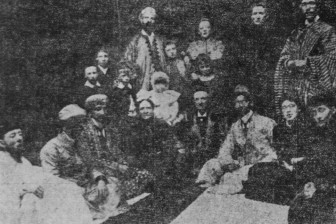
This entry includes information about the personal life of Abdullah Quilliam (1856-1932) and in particular about the two families in...
This is collection of places in Liverpool related to the life of Abdullah Quilliam (1856-1932), the founder of Britain's first attested mosque community in 1887, covering his multiple roles as a religious leader, as a lawyer, as a journalist, as a trade unionist and political activist, as well as his personal life.
This entry includes information about the personal life of Abdullah Quilliam (1856-1932) and in particular about the two families in...
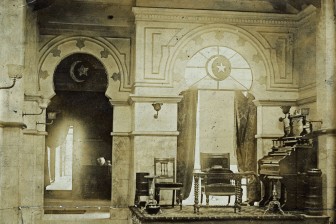
8 Brougham Terrace was the site of Britain's first attested mosque community, called the Liverpool Muslim Institute (LMI). It was...
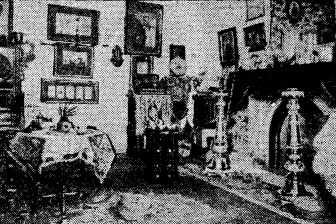
Built by the Quilliam Family, four generations lived in this house from the 1870s to the 1950s. Includes some biographical...
-Lord-Mayor-Liverpool,-MQRWU-President-and-founder-of-Liverpool-FC-overview.jpg)
A philanthropic body under the Poor Law Reform Act of 1832. Built workhouses, housing, schools and hospitals, including the famous...
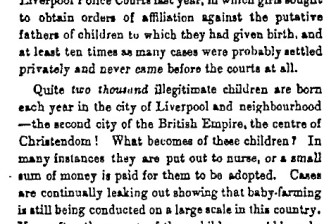
The Medina Home for Children was the first orphanage founded by Muslims in the UK, and was established in 1896....
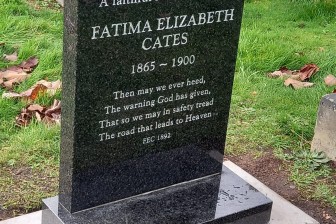
Fatima Elizabeth Cates (5 January 1865-29 October 1900) was probably the first woman to convert to Islam in Merseyside, who...
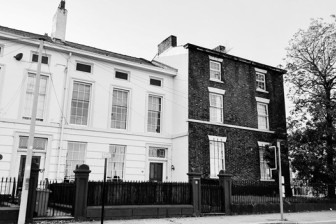
This was the residence of Fatima Elizabeth Cates (1865-1900), as listed in the 1891 Census, among the first women to...
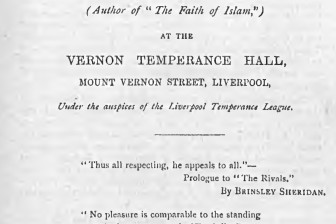
This was the site of the first Muslim prayer hall in the UK, which was formally established as the Liverpool...
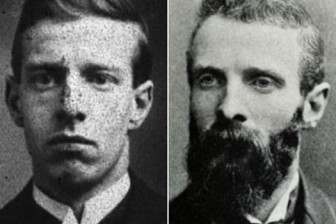
Fatima Elizabeth Cates (1865-1900) lived at "Granada", Victoria Road, in the town of West Kirby on the western side of...
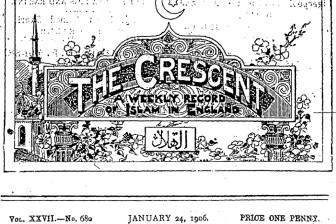
The first location of the printing offices of the first Muslim periodical published in Britain, the weekly Crescent (1893-1908), the...
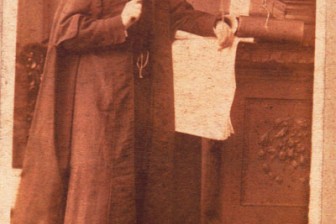
The Magistrates Courts (formerly known as the Police Courts) where the Muslim convert and solicitor William Henry Abdullah Quilliam (1856-1932)...
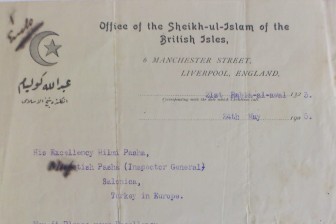
The chambers of Quilliam and Sons, headed by a convert to Islam, the lawyer and journalist, William Henry Abdullah Quilliam...
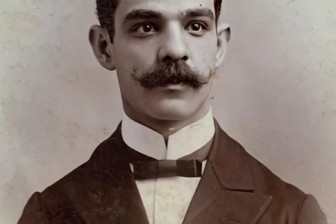
One nineteenth century couple are an early example of an intercultural Muslim marriage. They were Ali and Amy Mokaiesh who...
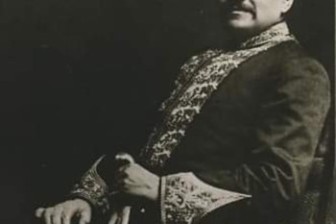
Mustapha Karsa (pictured circa 1900) was born in Damascus in around 1848 to a wealthy landowning family. In 1880-1, Karsa...
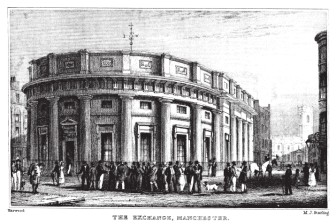
Abdullah Ydlibi [Idlibi] (c.1820-85) came from a family of Arab notables in administration, politics and trade, with branches in Damascus...
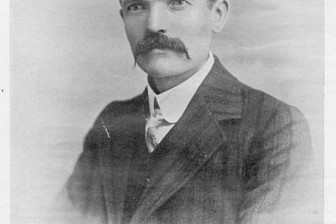
Yahya Parkinson (1874-1918), Scottish Muslim poet, essayist, and critic, was born in Kilwinning, Ayrshire, Scotland, of Irish descent. Born John...
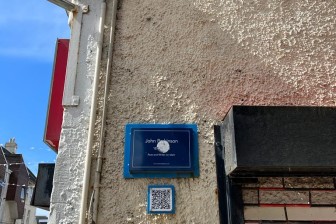
104 Main Street in Kilwinning, Ayrshire, was the birthplace and primary residence of John Parkinson (1874-1814), Britain's founding Muslim poet....
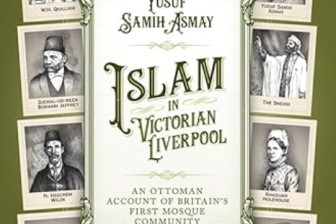
Islam in Victorian Liverpool is a unique eyewitness account dating from 1895 of Britain's first mosque community by an Ottoman...
20 December 1889 - June 1908

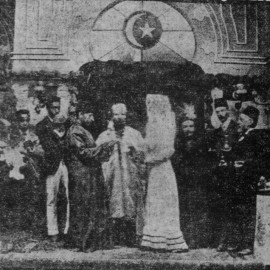
,-14-Apr-1904,-p.4-thumb.jpg)
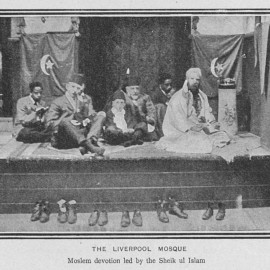
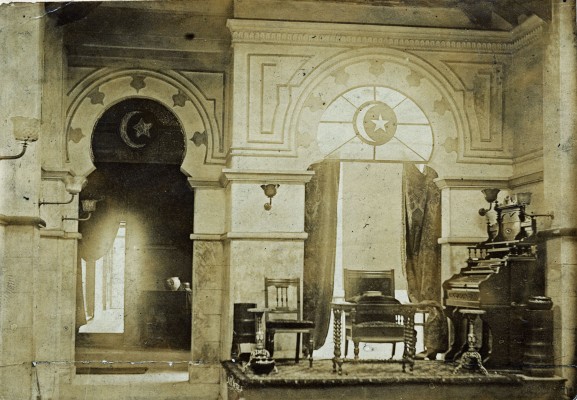
8 Brougham Terrace was the site of Britain's first attested mosque community, called the Liverpool Muslim Institute (LMI). It was founded by Abdullah Quilliam (1856-1932), a lawyer and journalist who converted privately to Islam in 1886 after a trip to Morocco in 1883 where he met some Muslim pilgrims and then the self-study of Islam from orientalist sources as well as other religions. In 1887, he began to call the people of Liverpool to Islam in an indirect manner through public speaking, and he ran the activities of the LMI from rented premises with a small number of converts for eighteen months from June 1887. At Brougham Terrace, the LMI ran between December 1889 and the summer of 1908. It is estimated that something like 250 converts embraced Islam with the LMI in this period. Most of them were working people with some middle class and highly educated people among them, who made up Quilliam's leadership team. As a great port, as news of an English mosque spread through Britain's imperial maritime routes and the press in British India, Turkey, Egypt and elsewhere, it was common for Muslim sailors (known as lascars), students and notables to visit the mosque and, at times, swell the congregation.
In 1890, the LMI took part in a successful campaign to have Sir Hall Caine's Mahomet withdrawn from the London stage. This introduced Quilliam and LMI to the most powerful Muslim stateman of the day, the sultan-caliph Abdulhamid II (r. 1876-1909) of the Ottoman domains, who became a patron after inviting the LMI President to Constantinople in 1891, the first of several visits. Quilliam would act twice on behalf of the sultan: firstly in 1894 to present an award to Muhammad Shitta Bey (1824-95) for establishing a new mosque in Lagos, and secondly he was sent on a fact-finding mission to look into uprisings in East Rumelia. Although he later claimed to have been appointed by the caliph as Sheikh-ul-Islam of the British Isles in 1894, there is no evidence of that in the Ottoman archives. Rather, he gained this position through the nomination and unanimous vote of the LMI's members in October 1894. This role was later recognised by the Amir of Afghanistan in 1903; the most that could be said about the Ottomans is that they tolerated his use of it and the claim that the caliph had granted it to him.
The religious services at the LMI initially had more of a syncretic or hybrid form combining Islamic doctrine with form of a Protestant Christian service with Anglican and Methodist features, along with hymns accompanied with an organ, and a sermon that was often anti-Christian in tone. This was held every Sunday at 7pm and continued throughout the LMI's lifetime: these were designed to invite those of a Christian background to Islam. A hymnal for these services was published in 1892. In the early years, Islamic prayers were also held but at fixed times. Overtime, Sunni Islamic practice became more institutionalised. At Brougham Terrace, the services offered by the LMI expanded. There were public lectures, a literary debating society, regular social gatherings (which sometimes included summer excursions), and there were formal celebrations of the two Eids, the Prophet's Birthday, the Ottoman caliph's birthday, and on Christmas Day a dinner was given for the local poor from 1889 onwards and was often covered by the Liverpool press. In addition, were added an Islamic school for children, a museum, a library, a photographic studio, a printing press, and an orphanage. This required the expansion of the Institute and Nos. 10 and 12 were added, first rented and later further renovated and purchased, with the aid of a gift of £2500 from the Amir of Afghanistan to the mosque in 1896. The mosque was used for both lectures and religious services, and was an extension built and added to 8 Brougham Terrace to the rear of the property.
When Abdullah Quilliam left England for Turkey in May 1908, his second son Billal Quilliam (1885-1965) sold the mosque premises to the local authorities. The community of converts around the mosque fragmented and in some cases dispersed. Over the decades Brougham Terrace served as the archives of the births, marriages and deaths in Liverpool, and registry marriages were conducted there. The annex was referred to by staff as "the mosque" without knowing its history.
In the 1970s, the local Muslim community became aware of this history. In 1998, they established the Abdullah Quilliam Society. In 2014, they succeeded in reopening the mosque for prayers after considerable refurbishment of the ground floor. The mosque can be visited by arrangement with the Society.
Yusuf Samih Asmay, Islam in Victorian Liverpool: An Ottoman's Account of Britain's First Mosque Community, trans. and eds. Yahya Birt, Riordan Macnamara and Munire Zeynab Maksudoglu (Swansea: Claritas Press, 2021).
Ron Geaves, Islam in Victorian Britain: The Life and Times of Abdullah Quilliam (Markfield: Kube, 2010).
Jamie Gilham, Loyal Enemies: British Converts to Islam, 1850-1950 (London: Hurst, 2014).
Jamie Gilham and Ron Geaves (eds), Victorian Muslim: Abdullah Quilliam and Islam in the West (London: Hurst, 2017).
Spotted an issue Report this record
Loading please wait