Key
- Building
- Blue plaque
- People
- Walks / Tours / Trails
- Museum and Archive
- Heritage Project
- Organisation or Family History
- Cemeteries & graves
- Academia
- Publication and Articles
- Place
- Digital Resources
- Art & Culture
- Film and TV
- Mosques and Shrines
- Monuments /Memorials
As you move and zoom the map this panel will show you all the records that are currently in view on the map.
-Lord-Mayor-Liverpool,-MQRWU-President-and-founder-of-Liverpool-FC-thumb.jpg)
-(1)-thumb.jpg)

-thumb.jpg)

-thumb.jpg)


-thumb.jpg)
-(1)-thumb.jpg)









-thumb.jpg)






















4 May 1904 - 29 October 1904
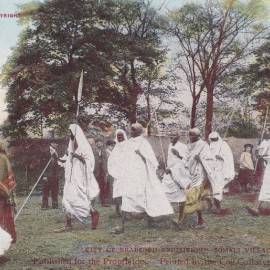
A Somali Village in Colonial Bradford (1904)
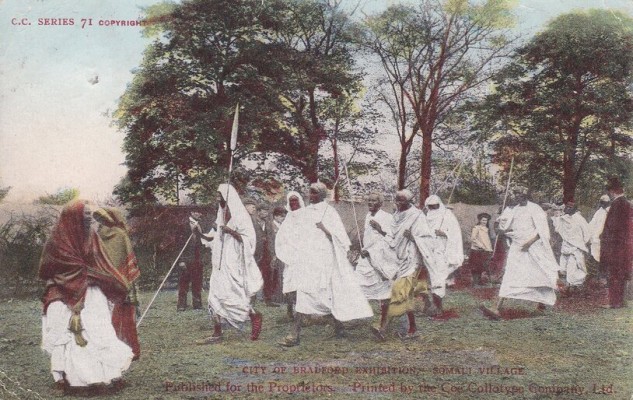

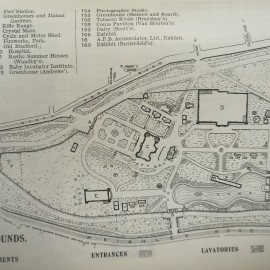
In 1904, the great Bradford Exhibition was held in Lister Park. It was held to inaugurate the newly-built Cartwright Hall, a gift to the city from Lord Masham (1815-1906), the proprietor of then what was the largest silk textile factory in the world, the Lister Mills, and to promote Bradford's businesses. However, the Exhibition was not all business, as the city's councillors planned to make it popular and profitable with a mix of entertainments and concerts. In this, they succeeded as 2.4m attended the Exhibition during its six months of operation between May and October, and it made an overall profit of £13,000.
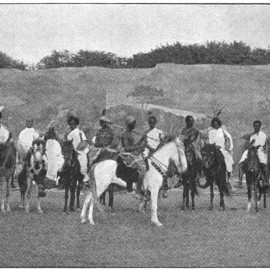
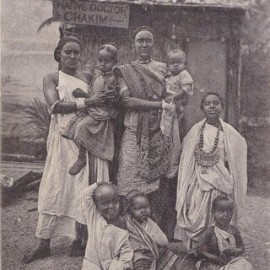
The star attraction of the Bradford Exhibition of 1904 was in fact what was called one of its sideshows - the Somali Village, which was placed at the north end of the park, just west of the park's ornamental lake. For six months, a hundred individuals lived in a recreated village - sixty men, twenty women and twenty children - within a walled compound. In total, 348,550 visited the Somalis inside the compound, and it was by far the most profitable of the entertainments on offer, making £8216, compared with the Water Chute which made less than half that amount and the Crystal Maze, an eighth.
When the Somali Village came to Bradford, Britain was in the midst of a war of imperial conquest in Somaliland. Following Somaliland's imperial division by the French, Italians and the British in the late nineteenth century, Sayyid Muhammad Abdille Hassan (1864-1920) led a twenty-year campaign of resistance by Sufis of the Salihiya Order, hence their nicknaming as "Dervishes", against British colonial incursion. Between 1900-4, the British mounted four major incursions against Hassan, whom they dubbed the "Mad Mullah". At the time, the Yorkshire press patriotically reported British progress and setbacks, as Hassan continually evaded capture, and scored the odd victory against the more heavily armed British among a number of setbacks.
The official Exhibition Catalogue introduced the Somali troupe in a manner that showed full awareness and support for the imperial campaign in their home country:
'[A] troupe of about 100 Somalis, from the Coast of East Africa, who are installed in Bradford after a very successful tour on the Continent. [...] the Somalis are absolutely new and afford for the first time in this country an illustration of that little known but interesting people. The troupe consists of male and female natives, including adults and children, with a Native Chief and Mullah. Native customs, pastimes, occupations and ceremonies are shown; and among the demonstrations wrestling and spear throwing are especially entertaining. The title “Mullah” is given to their priest who accompanies them. He is not the identical Mullah upon whose head a price has been set by the British Government, but only one of a class of authorities occupying the position of tribal priest.'
When it was announced in April before the Exhibition got underway the following month that the Somalis would serve as last-minute replacements for an Ashanti village, local fears were assuaged by the Yorkshire press presenting the troupe as loyal Somalis who bore no connection with the Mad Mullah. The troupe had been brought over by the entrepreneur Victor Bamberger (1864-1937), the former secretary of Vienna's Zoological Gardens, after being approached by Bradford's city fathers; Bamberger later managed to gain the concession to run all of the Exhibition's entertainments. Bamberger's company, the British and Continental Enterprises Syndicate, employed a couple of handlers who also acted as fixers, translators and press officers. The troupe was presented to Yorkshire public as an authentic Somali village but, as the above description shows, this was a contractual affair.
Both parties expected to make money, but it was an asymmetric contract: the ordinary Somalis earned £7-12 for six months of long days with no breaks; those who practised crafts like weaving or metalwork or held a profession like the imam were paid slightly more. The troupe's leader, presented as the village chief, Sultan Ali, was a cosmopolitan figure who spoke six languages: he earned £42 for the whole duration. Handicrafts like pottery and fabrics were sold, and the Somalis expected visitors to pay to take photographs, which could sometimes lead to disputes with those who took snaps without payment.
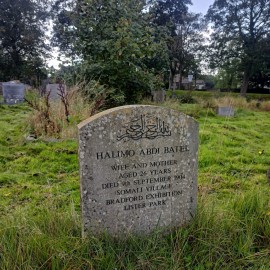
Bamberger had brought the troupe to Bradford from Nice, France, where they had set up another native village, earlier in 1904. This was part of a longer enterprise as Bamberger toured a troupe, sometimes presented as a Somali village and sometimes as an Abyssinian village, throughout Europe in the first decade of the twentieth century - this included several towns and cities in Germany as well as tours to other major European cities such as St. Petersburg, Amsterdam, Dublin, Prague and Vienna. It is uncertain how many participants would continue from one tour to the next, as the troupe would typically return home to Somaliland for the winter months between each tour, unless an indoor exhibition had been booked for the winter months. Nonetheless, there is evidence that some individuals did come repeatedly to Europe, such as Halimo Abdi Betal (see the separate entry), who came to England twice.
While the core of the troupe hailed from a sheepherding Somali village background and included families, the evidence from a 1905 show that Bamberger recruited for a "Somali" village in Oldenberg, Germany, through his agent Edmund Porfi, shows that he cast his net more widely for specific occupational and entertaining skills, recruiting from Egypt, Abyssinia, and all parts of the Somali coast and the interior, which had been divided between France, Britain and Italy. An ethnographer in Berlin meeting the same troupe thought that it also included some people from Eastern Sudan and even an Indian.
Imperial expansion and trade brought new seasonal employment opportunities for some Somalis. The Somali language itself had specific terms for these new professions, for example, "taccabir", used since the nineteenth century or earlier to refer to overseas travellers, and applied to Somalis recruited as sailors into the European merchant fleet going through the Suez Canal. There was also a specific Somali term "carwo" for participants in the troupes themselves, who performed in the staged native villages in Europe in what were called "Völkerschauen" or ethnological shows. Local brokers and troupe leaders for European recruiters to these shows like Sultan Ali had emerged from 1885 onwards, when another German entrepreneur, Carl Hagenbeck, began to recruit in Somaliland for his shows. On the Somalis' last day in Bradford, Sultan Ali remarked that his troupe had been changed by their experience of touring in France and England, and were unlikely to return to their original occupation as sheepherders.
It is clear from the descriptions in the Yorkshire press that the troupe were devout Muslims: they slaughtered their own sheep for halal mutton, and prayed their daily prayers in congregation on a platform built for the purpose that faced Makkah. The Mullah acted both as a religious teacher to the children (at the Village school) and as an imam to the adults through lessons and lectures from the Quran and Hadith; he had a secondary role as a hakim, a traditional doctor, who handed out herbal and spiritual remedies. There is one account in the Bradford Weekly Telegraph (21 May 1904) of a Quran commentary and lessons from the Prophet's life given by the Mullah, which was notable in presenting the fundamentals of Islam to the locals through translation. It is also clear that amidst the performance of staged fighting or presentation of occupations like metalworking and weaving, social life continued too with a birth of a girl, a divorce, and a funeral (see the entry on Halimo Abdi Batel in this collection). As he did in other cities in Europe, Bamberger was quick to advertise the fortuitous birth of a child: in the case of Bradford, 'Princess' Hadija was allegedly given the middle name of 'Yorkshire' and greeted with a 17-gun salute.
Racialized language was a persistent feature of the reporting, the personal accounts and correspondence published in the Yorkshire press, and their depiction as primitives effected the style of amateur ethnography, larded with heavy doses of condescension presented as humour. The adult Somalis were often presented as childlike and temperamental, as prone to overreact to difficulties, counterpoised to the more stoic British. The children were by praised for their quick wittedness and openness to British ways, while being criticized for soliciting tips.
These racialized presumptions readily came to the fore during a dispute over loss of goods worth £200-300 after a fire on the evening of 30 August destroyed four huts, some of which served as storehouses for troupe's goods that had been purchased both in France and Britain. The local fire service did not investigate the cause of the fire, but only assessed the speed to which it responded to the fire alarm. One unexamined potential cause came in a letter to the Bradford Daily Telegraph (1 September 1904) from an employee who sold postcards at a kiosk in the Village who said that locals were continuously giving the children matches and paper to play with, which was never brought under control.
On the day of their departure, matters came to a head when Sultan Ali and the Village's men went to protest the lack of compensation for this loss to the City Mayor at the Town Hall. Victor Bamberger and Councillor William Charles Lupton (1849–1918), chair of the Exhibition's Executive Committee and a former Mayor of the city, were sent for. Collectively, the city officials and the contractor not only denied any compensation but insisted that fire was the fault of the Somalis themselves, although why or how is not explained (Shipley Times and Express, 4 November 1904).
On their last day in Bradford, the Somalis exchanged their white calico for Western dress, which generated a good deal of arch commentary in the Yorkshire press about fashion sense. Crowds and the Mayor and Mayoress of the city saw them off at Bradford's Interchange station. The troupe took to train to Hull and a then a ship to Rotterdam to catch another to Aden and then a final one to the Somali coast. The press noted that the troupe would appear at another exhibition in continental Europe the following year.
Collections this record belongs to
Sources and Attribution
Britishnewspaperarchive.co.uk (for local Yorkshire Press coverage of the Somali Village)
I.M. Lewis, A Modern History of Somalia (Boulder, Co: Westview Press, 1988), 3rd edition, Chapters 2 and 3.
Marion Jourdan, "Koloniale Spektakel, kosmopolitische Kontaktzonen: Völkerschauen in Mannheim", in Bernhard Gißibl and Katharina Niederau (eds), Imperiale Weltläufigkeit und ihre Inszenierungen: Theodor Bumiller, Mannheim und der deutsche Kolonialismus um 1900 (Göttingen: Vandenhoeck & Ruprecht, 2021), pp. 291-335.
Evelyn Kroos, "Das Somali-Dorf in Oldenburg 1905 – eine vergessene Kolonialgeschichte? Eine Völkerschau in der Provinz" in Fabian Fechner and Barbara Schneider (eds.) Fernes Hagen: Kolonialismus und wir (Hegen, 2021), pp.110-14.
WYAS Bradford, 39D90/2 City of Bradford Exhibition May to October [1904] Official Catalogue, p.49.
WYAS Bradford, BBD1/1/48/46, Record of Admissions and Receipts, Somali Village, etc., p.18.
Licensing
Spotted an issue Report this record