Key
- Building
- Blue plaque
- People
- Walks / Tours / Trails
- Museum and Archive
- Heritage Project
- Organisation or Family History
- Cemeteries & graves
- Academia
- Publication and Articles
- Place
- Digital Resources
- Art & Culture
- Film and TV
- Mosques and Shrines
- Monuments /Memorials
As you move and zoom the map this panel will show you all the records that are currently in view on the map.

-Lord-Mayor-Liverpool,-MQRWU-President-and-founder-of-Liverpool-FC-thumb.jpg)
-(1)-thumb.jpg)
-thumb.jpg)
-thumb.jpg)


-thumb.jpg)
-(1)-thumb.jpg)





-thumb.jpg)
















1868
FCDO: Foreign, Commonwealth & Development Office
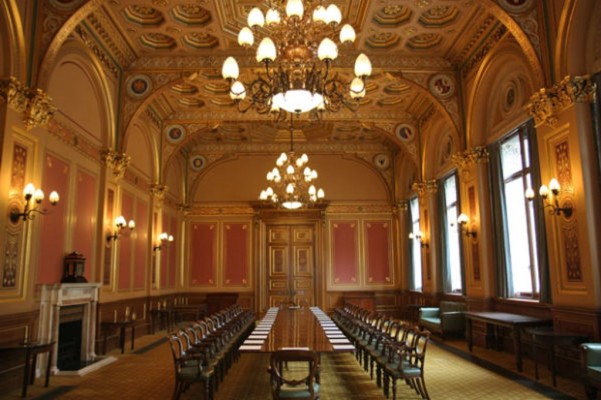
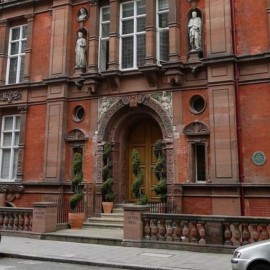
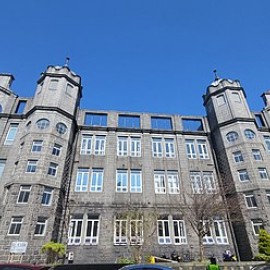
Originally constructed in 1868 as a set of government offices, including the India Office and later the Colonial and Home Offices, the offices underwent significant changes over time.
The India Office, previously a separate department, played a crucial role until 1947 when it was dissolved following the Partition and Indian Independence. Prior to the 1857 Rebellion, India was administered by the East India Company, whose headquarters were located at East India House on Leadenhall Street, now known as the Lloyd's (Inside-Out) Building.
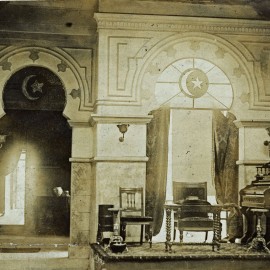
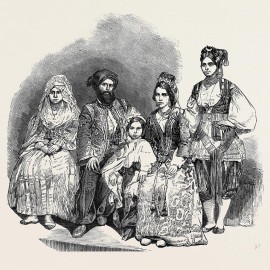
Renowned architect George Gilbert Scott designed the FCDO, collaborating with Matthew Digby Wyatt, who designed the interior of the Indian Office. Together, they aimed to create an elaborate and impressive structure, akin to a national palace, to welcome foreign visitors. The building hosted numerous public events, such as receptions for dignitaries like the Sultan of Turkey in 1869 and the coronation celebration of King Edward VII in 1902.
The centrepiece of the India Office was the Durbar Court, designed by Wyatt. Durbar means ‘the court of an Indian ruler’. This (originally) open-air court featured three levels of columns and arches, showcasing polished red Peterhead granite, grey Aberdeen granite, and marble from Greece, Sicily, and Belgium. Notable occasions, including the reception for the Sultan of Turkey and the coronation celebration, took place in this grand court.
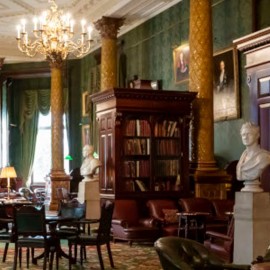
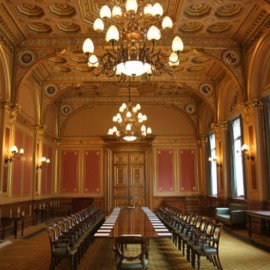
Wyatt also designed the India Office Council Chamber, a lavishly adorned space where the secretary of state for India and his council deliberated on matters concerning the subcontinent. Gilded accents, a marble chimneypiece, and intricately carved tables and chairs, now housed at the India Office Library in the British Library, added to its opulence. The chamber retains original 19th-century mahogany chairs, a newspaper stand, and the chairman's seat bearing the East India Company's crest.
During the Sultan of Turkey’s famous visit, this chamber was transformed into a dining room for the Sultan, the Prince of Wales and other important guests; it was reported that every item on the tables was made of gold.
Following Independence and Partition, the Foreign Office assumed control of the building to meet its expanding office needs. It housed the German Department and served as the venue for the 1948 Three-Power Conference on Germany. Additionally, preliminary discussions related to the first meeting of the NATO deputies took place in the India Office Council Chamber, with the nearby archives of the secretariat.

Collections this record belongs to
Sources and Attribution
Author: Jeea Chadha, A little History of the Sikhs Sources and Attributions https://www.gov.uk/government/history/king-charles-street https://en.wikipedia.org/wiki/Matthew_Digby_Wyatt https://en.wikipedia.org/wiki/East_India_House
Photos: A little History of the Sikhs
Licensing
Spotted an issue Report this record