Key
- Building
- Blue plaque
- People
- Walks / Tours / Trails
- Museum and Archive
- Heritage Project
- Organisation or Family History
- Cemeteries & graves
- Academia
- Publication and Articles
- Place
- Digital Resources
- Art & Culture
- Film and TV
- Mosques and Shrines
- Monuments /Memorials
As you move and zoom the map this panel will show you all the records that are currently in view on the map.
-Lord-Mayor-Liverpool,-MQRWU-President-and-founder-of-Liverpool-FC-thumb.jpg)
-(1)-thumb.jpg)
-thumb.jpg)
-thumb.jpg)
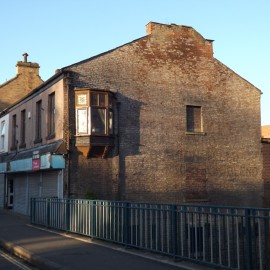
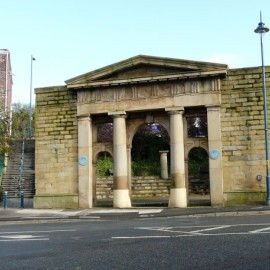
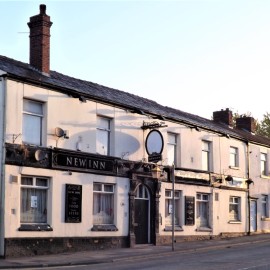
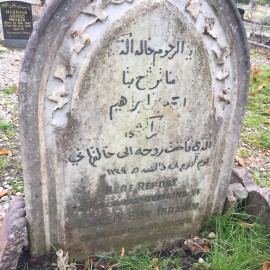

-thumb.jpg)
-(1)-thumb.jpg)
-thumb.jpg)







1971
Unsung heroes of Bangladesh’s independence movement
Millions of souls Nineteen seventy one
homeless on Jessore Road under the Gray sun
A million dead, the millions who can
Walk toward Calcutta from East Pakistan
September on Jessore Road, Allen Ginsberg
During the Liberation War of Bangladesh in 1971, many worldwide supported Bangladesh and its people by expressing concerns, condemning Pakistani acts, and going & physically fighting with the freedom fighters. Among some of the most famous were US senator Edward Kennedy, French philosopher Andre Malro, Ustad Rabi Shankar & George Harrison, who had organised the Bangladesh Concert, British journalist Simon Dring, Anthony Mascarenhas & Mark Tully, Jyoti Basu of West Bengal, American poet Allen Ginsberg, British MP John Stonehouse, Bruce Douglas Mann, Peter Shore & Lord Ennals, Paul and Ellen Connett of UK’s Action Bangladesh, German author Gunter Grass, Soviet president Nicolai Podgorni and of course Indian premier Indira Gandhi who tirelessly campaigned for Bangladesh amongst the world community.
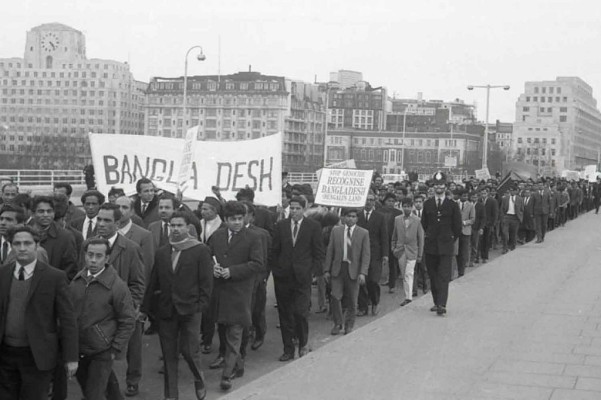
Many Bengalis & non-Bengalis, in the UK played a vital role, especially in creating awareness and lobbying the world community. In 1971, though small, there was a sizeable Bengali community in the UK, including London, Luton, Birmingham and Manchester. It is interesting to note that Bengalis were active in political discourse before 1971 as they supported Awami League’s Six Point programme in 1966, which demanded greater autonomy for East Pakistan and campaigned for Sheikh Mujibur Rahman’s release after he was arrested in 1968 in the Agartala conspiracy case. The UK Bengalis sent English lawyer and QC Sir Thomas Williams to defend Sheikh Mujibur Rahman and others charged with treason.
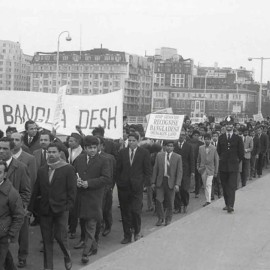
During the War of Bangladesh in 1971, the UK Bengali community, including women, played a key role in highlighting the atrocities in Bangladesh, lobbying the British government and the international community and raising funds for refugees and the Mukti Bahini. Bengali communities across the UK formed Action Committees in support of the liberation in Bangladesh. Some key organisations were the Student Action Committee, Bangladesh Women’s Association, regional Action Committees, eighty-five in all, Action Bangladesh formed by British activists and UK branches of Awami League.
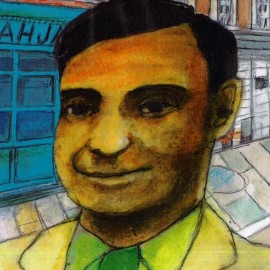
Mrs Anowara Jahan of the Bangladesh Women’s Association (BWA) handed in letters to different MPs in the House of Commons for support of the War of Liberation. She was closely linked to Michael Barnes MP and John Stonehouse MP. She wrote letters on behalf of the BWA to different world leaders. She attended the Labour and Conservative annual party conferences raising awareness among political leaders about the genocide in Bangladesh.
Mrs Kulsum Ullah, another member and organiser of the Bangladesh Women’s Association in Britain, was associated with raising funds and relief for the War of Liberation. In an interview, she described organising rallies, ‘The campaigns were usually arranged on Sundays and almost regularly. The whole nine months, I was busy keeping aside my kids and family…The largest women’s gathering was achieved in the biggest demonstration. I alone took 150 women at least … People from all over the UK participated in all the rallies; they came from Birmingham, Manchester, Leeds and Bristol, all parts of England.’
It is said that some people donated their entire week’s salary and at least in one case, a woman donated her entire wedding gift of gold jewellery. Mrs Badrun Nesa Pasha was that woman and one of the founding members of the Birmingham Action Committee, an active supporter of the War of Independence. She was the woman who donated her entire matrimonial jewellery after she delivered a passionate speech in front of thousands of supporters in a demonstration where the flag of Bangladesh was raised in Small Heath Park, Birmingham.
According to Mrs Pasha, people were willing to go and fight in Bangladesh. Mrs Pasha narrated, ‘We organised a demonstration and a camp to recruit volunteer fighters for the liberation of Bangladesh because the war was becoming quite heavy. Some people in Birmingham started recruiting young people who wanted to be volunteers to go on the battlefield. There was a queue for the selection and recruitment. An English bartender came and said, “I want to fight for the Bangladesh liberation movement.” That was quite interesting for us and we couldn’t believe that white people were ready to fight for Bangladesh.’
A key feature of this period was the support provided by members of the white British majority – in this case, politicians, diplomats, lawyers and journalists. Amongst them was Mr Michael Barnes, a Labour MP at the time for Brentford and Chiswick in West London. He went to Bangladesh during the war. In the parliament, he gave a picture of the genocide happening in Bangladesh.
Another British diplomat based in India talked about their unofficial support for Sheikh Mujibur Rahman and the Bangladesh cause. Mr Miles was the Deputy High Commissioner, Kolkata, India, 1970-74 and High Commissioner, Bangladesh, 1978-79. He witnessed the gathering of half a million people in Kolkata in January 1972 when Sheikh Mujib flew from London on his way back to independent Bangladesh. As a diplomat, he visited many refugee camps in Kolkata where the Indian Government accommodated ten million Bengali refugees who fled Bangladesh.
To date, no comprehensive history of the independence movement in the UK or the contribution of White British and the local Bengali community has been documented. A few, including Justice Abu Sayeed Choudhury, special envoy of Mujibnagar Govt, writer Abdul Matin, community historian Yousuf Chowdhury, Sheikh Abdul Mannan of Steering Committee and the Bangladesh Welfare Association have attempted to document the history of the contribution of the diaspora Bengali community.
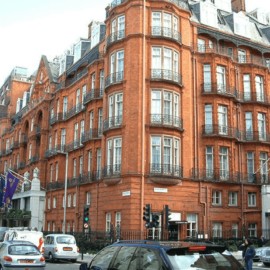
It should be mentioned here that following the end of the war and his release from Pakistan, Bangabandhu Sheikh Mujibur Rahman came to London, stayed and held his first press conference on 8 January 1972 in Claridge’s Hotel. Less than a month after, Britain became one of the first countries to recognise Bangladesh as an independent nation. This move encouraged other Commonwealth and Western powers to follow suit.
At the Claridge’s, the momentous meeting between Bangladesh’s founding father, Sheikh Mujibur Rahman and the then British Prime Minister Sir Edward Heath took place later in 1972. It was a special moment in an enduring friendship between the two nations. Sir Harold Wilson, Leader of the Opposition from the Labour Party and former British Prime Minister also met Sheikh Mujibur Rahman in Claridge’s.
In 2005, the Swadhinata Trust, a small voluntary organisation, embarked on an oral history project to record the memories of some who had participated in the independence movement. Memories of the War of Independence and the community involvement through the oral history project clarified some of the mechanisms through which it was fought and added new information when analysing interviews with ordinary people in the UK. But of course, many facts remain to be revealed about the War of Independence of Bangladesh and the movement in the UK.

Collections this record belongs to
Sources and Attribution
Author: Ansar Ahmed Ullah
Licensing
Spotted an issue Report this record